
My role
Product development; bounded public demonstration
The result
The comparison produces a bounded diff and a readable explanation tied to the actual input fields. Visitors can test how a rule changes the result without accessing an external website.
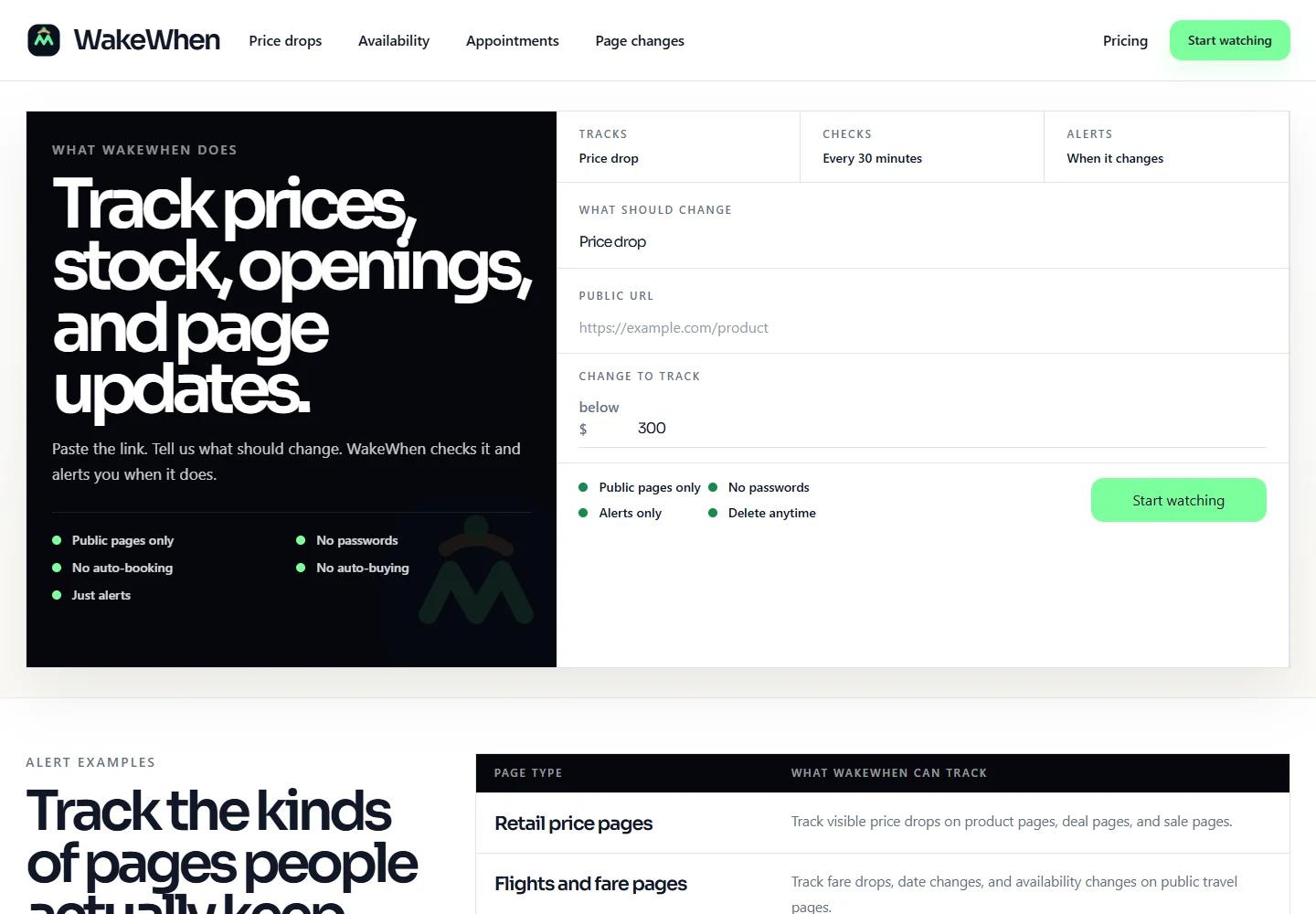 Open the public website in a new tab
Try the separate demonstration
The lab compares included fictional snapshots. It does not monitor this website or visitor-supplied URLs.
Open the demonstration01
The problem
A page can change without anything useful changing. Monitoring becomes useful when it can distinguish a price movement or a newly available item from whitespace and formatting noise.
02
Operational context
WakeWhen is a separate product concerned with public-webpage change monitoring and alerts. This site's example uses bundled fictional snapshots to explain a deterministic comparison; it does not connect to the product or monitor third-party pages.
03
My contribution
I built the public example around explicit fields and explainable rules. Visitors can vary price, availability and item presence, then inspect the normalized values and the reason a notification preview appears.
04
Constraints
- Only bundled snapshots of a fictional item.
- No visitor-provided URL, account access or credential collection.
- No CAPTCHA bypass, automated purchase or booking.
- Notification previews stay on screen; no email or SMS is delivered.
05
Implementation decisions
- Normalize irrelevant whitespace before comparison while preserving meaningful price and availability differences.
- Report combined changes in a deterministic order instead of selecting a single arbitrary label.
- Treat a missing item and an invalid snapshot as explicit, different states.
- Keep the newly built example distinct from any claim about the product's deployed infrastructure.
06
Alternatives considered
- Comparing raw HTML alone would confuse presentation edits with useful changes.
- A model-generated explanation could invent a difference; explicit comparison rules are sufficient here.
- A public arbitrary-URL fetcher would introduce network access unrelated to this controlled demonstration.
07
Validation approach
- Unchanged content, price increases and decreases, and availability transitions.
- Removed items, malformed snapshots, combined changes and stable ordering.
- Whitespace-only edits leave meaningful fields unchanged.
08
What this shows
The comparison produces a bounded diff and a readable explanation tied to the actual input fields. Visitors can test how a rule changes the result without accessing an external website.
09
Limits of the evidence
- The demonstration does not establish that WakeWhen is commercially live or measure production alert delivery.
- Real-world selectors, scheduling and external-site variability are outside this example.
- WakeWhen and Vaultaproof are distinct projects.
Inspect the work
A similar problem in your organization?
This example can be a starting point for defining your own project, its dependencies and acceptance criteria.