
My role
Product development; public synthetic reconstruction
The result
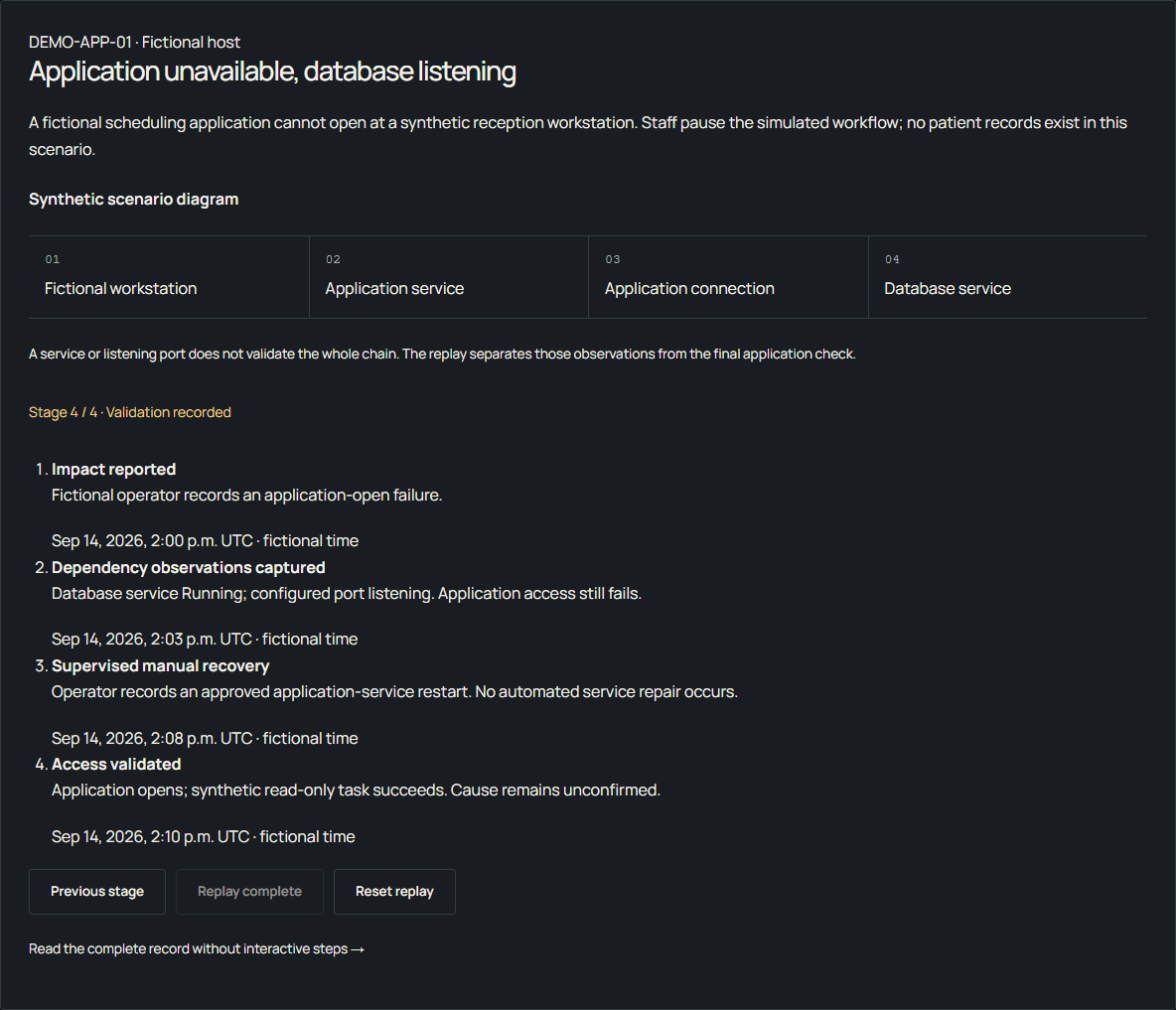
A reader can follow why an action was chosen, which evidence supports it, and which questions remain open. The application-outage replay ends with restored access and an unconfirmed underlying cause.
01
The problem
An unavailable application does not automatically imply a failed database. Recovery work becomes less reliable when observations, possible causes and permitted actions are collapsed into a single confident diagnosis.
02
Operational context
Axiom's documented architecture is a local Windows application with WPF, a service host, SQLite and named-pipe communication. The public experience reconstructs two fictional incidents; it does not run the Windows product or inspect the visitor's device.
03
My contribution
My focus is making diagnostic evidence and action boundaries understandable. This reconstruction exposes observations, competing explanations, a proposed intervention and the checks needed after recovery, without implying that a successful restart proves a cause.
04
Constraints
- No patient charts, vendor-database writes or remote fleet control.
- Axiom-owned storage and runtime recovery form the product's narrow executable remediation boundary.
- Service-impacting maintenance is operator guidance, not an unattended vendor repair.
- Every public replay action changes synthetic narrative state only.
05
Implementation decisions
- Keep observed service state and listening-port evidence separate from application health.
- Record a supervised service restart as a manual intervention, then validate the application response separately.
- Expose the data-root permission denial and rejected arbitrary export path without expanding the recovery allowlist.
- Use the same scenario record for technical detail and the operational summary.
06
Alternatives considered
- Declaring a database root cause from a failed application check would overstate the evidence.
- An automatic Windows, SQL, printer, DNS or time-service repair would misrepresent the documented product boundary.
- A real device scan is unnecessary for explaining the investigative method and would introduce unrelated access and privacy risks.
07
Validation approach
- Deterministic scenario replay and reset.
- Before-and-after evidence distinguishes service restoration from cause confirmation.
- The storage scenario preserves the denied export boundary and distinguishes observed denial from inferred explanation.
08
What this shows
A reader can follow why an action was chosen, which evidence supports it, and which questions remain open. The application-outage replay ends with restored access and an unconfirmed underlying cause.
09
Limits of the evidence
- The product architecture is source-described; this case does not claim an independent audit or a verified production deployment.
- The browser replay is synthetic and performs no local diagnostics or repairs.
- The public experience is not an installer, clinical tool or medical-device claim.
Inspect the work
Explore the synthetic diagnostic replay
A similar problem in your organization?
This example can be a starting point for defining your own project, its dependencies and acceptance criteria.